
Ashwagandha is best known as a stress-relief adaptogen, but its impact on skin biology is far more impressive than most people realise. When formulated correctly, this botanical does not just soothe stressed skin. It actively supports hydration, elasticity, pigmentation balance, and repair at a cellular level. Clinical data now shows that standardized Ashwagandha extracts can visibly improve signs of photoaging while calming inflammation and protecting the skin’s structural proteins. This combination of measurable results and multi-pathway activity is what positions Ashwagandha as one of the most promising botanical ingredients in modern skincare.
Why Ashwagandha matters for skin
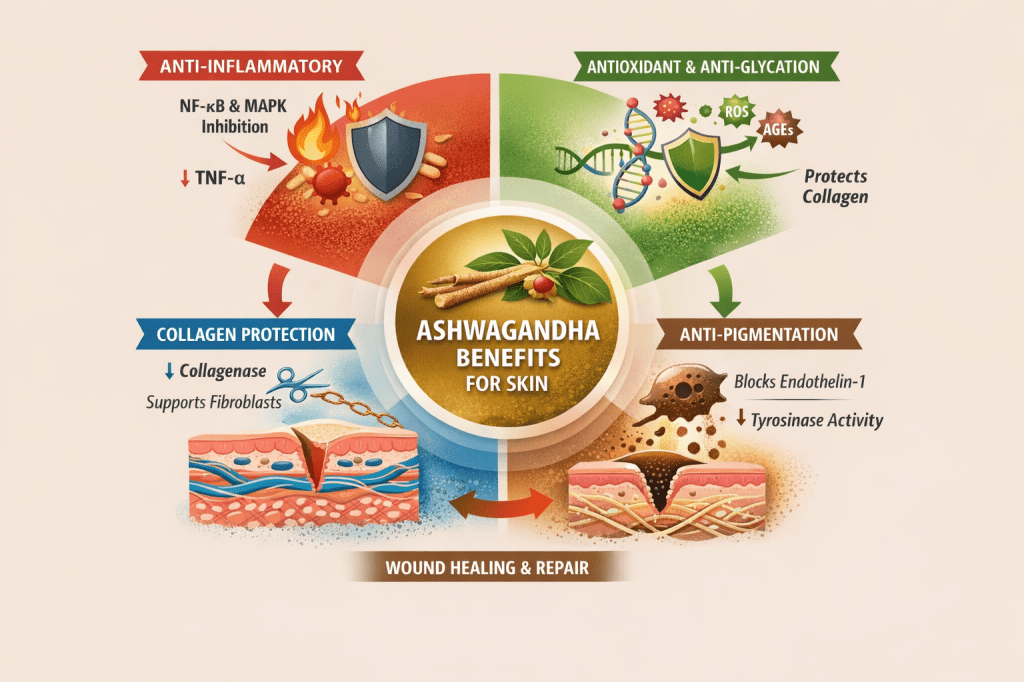
Ashwagandha is an adaptogen that actually translates to useful, multi-target skin biology. The active chemistry centers on withanolides such as withaferin A, plus withanosides and glycosides that together:
- calm inflammatory signalling in keratinocytes and fibroblasts,
- scavenge reactive oxygen species and reduce glycation,
- protect the dermal matrix by inhibiting collagenase, and
- reduce melanogenic signalling via endothelin-1 and MITF pathways.
In plain terms: it soothes inflammation, protects structural proteins, helps correct pigmentation, and speeds tissue repair. When suppliers standardize extracts to defined withanolide levels, the results are repeatable.
What the clinical data shows
There is solid human data for topical use when the extract is standardized.
Key clinical outcomes from a randomized, double blind, placebo-controlled trial using 8% standardized root extract over 60 days:
- Global physician signs reduced by 74.69% versus 48.68% with placebo.
- Skin hydration improved 20.66% versus 9.5% placebo.
- Skin elasticity (R2) improved 16.34% versus 3.73% placebo.
- Transepidermal water loss decreased, and melanin index showed measurable reduction.
- No significant safety signals; tolerability matched placebo in the trial population.
Other supporting data and preclinical results:
- Withaferin A alone inhibited collagenase by about 45.7%. Combining WFA with EGCG increased inhibition to about 79.08%.
- In keratinocyte models, extracts reduced TNF-alpha expression by up to about 55% at 0.5 mg/mL and increased TGF-beta1, which helps repair.
- Wound healing models show faster contraction and stronger healed tissue – for example, wound contraction reached about 98.3% by day 16 in treated animals versus 93.1% in controls.
Bottom line: standardized topical Ashwagandha produces consistent, clinically meaningful improvements for photoaged skin and supports barrier and repair endpoints.
| Skin benefit | What the evidence shows | Why it matters |
|---|---|---|
| Hydration | Skin hydration increased by about 20% after 60 days of use, compared to about 9% with placebo | Better hydration supports a stronger skin barrier and smoother texture |
| Elasticity and firmness | Skin elasticity improved by about 16%, compared to under 4% with placebo | Improved elasticity is linked to firmer, more youthful-looking skin |
| Visible signs of aging | Overall clinical signs of photoaging reduced by nearly 75% in a controlled study | Indicates broad improvement in wrinkles, texture, and tone |
| Inflammation reduction | Inflammatory markers such as TNF-alpha reduced by up to 55% in lab models | Lower inflammation helps calm sensitive or stressed skin |
| Pigmentation support | Melanin production pathways suppressed through endothelin-1 and tyrosinase inhibition | Helps improve uneven tone and dark spots over time |
| Skin repair | Faster wound closure and stronger healed skin in preclinical models | Supports skin recovery and resilience |
How it works
- Anti-inflammatory: suppresses NF-kB and MAPK signalling, lowers TNF-alpha and other pro-inflammatory mediators.
- Antioxidant and anti-glycation: reduces ROS and AGE formation, helping preserve collagen mechanics.
- Matrix protection: directly inhibits collagenase and supports fibroblast survival and collagen deposition.
- Anti-pigmentation: blocks keratinocyte-derived EDN1 signalling and downstream MITF activity, and also has direct tyrosinase inhibition.
- Repair and antimicrobial support: speeds epithelialisation, increases tensile strength, and shows activity against common skin pathogens in preclinical models.
Consumer benefits
- Helps improve skin hydration and barrier function with regular use.
- Supports improved elasticity and reduced visible signs of photoaging.
- Contributes to more even tone and reduced pigmentation when used with photoprotection.
- Shows promise for scalp health and hair retention in targeted serum formats.
Suggested user-friendly claims that stay safe unless you run finished-product clinicals:
- “Supports skin hydration and visible firmness with regular use.”
- “Contains Withania somnifera extract to support skin resilience and tone.”
If you want to use specific percent changes in marketing, run finished-product studies in the same formulation and packaging.
Formulation guide for product teams
These are practical, actionable recommendations for R&D and formulation.
Standardization and raw material
- Buy extracts standardized to a declared withanolide content. Clinical topical data most commonly uses an 8% root extract or extracts standardized to similar withanolide levels.
- Require COA, HPLC fingerprint, batch variability data and microbial testing from suppliers.
Concentration guidance
- Facial anti-aging lotions: clinical evidence supports 8% standardized root extract in a lotion vehicle.
- Serums and scalp treatments: use concentrated extracts with vehicle choice adapted to penetration goals; hair trials used concentrated serums with positive outcomes.
- Combination formulas: synergy with EGCG is well supported for stronger collagenase inhibition; consider lowering Ashwagandha loading if you validate synergy and stability.
Vehicles and sensory
- Hydrogels: ideal for oily or reactive skin and for pH tuning.
- Oil-in-water creams / vanishing creams: good option for dry, photoaged skin to deliver hydration plus actives.
- Serums: use for scalp delivery or targeted facial treatments; consider penetration enhancers validated for follicular uptake when designing scalp products.
Stability and compatibility
- Ashwagandha is generally stable, but polyphenolic partners like EGCG need pH control and antioxidant management to avoid oxidation.
- Run accelerated and real-time stability focusing on withanolide assay retention, sensory changes and microbial stability.
Packaging and manufacture
- Use standard cosmetic best practices: opaque or airless packaging, low headspace, and manufacturing controls that minimize heat and oxidation.
- Include chelators if trace metals are a concern, because metal catalysis can affect polyphenolic stability.
Safety and regulatory notes
- Topical trial data shows tolerability comparable to placebo for an 8% standardized extract. Patch testing is still recommended for sensitive skin positioning.
- Watch for Solanaceae allergies in consumers; add appropriate warnings and recommend patch testing for sensitive users.
- For any therapeutic wound healing or medical claims, follow medical device or drug pathways with appropriate clinical protocols. Cosmetic claims should remain non-therapeutic unless you pursue regulatory routes.
Practical product development checklist
- Source a standardized extract and secure COA and stability data.
- Choose a target claim and finalize vehicle – hydrogel for oily skin, lotion for dry skin, serum for scalp.
- Run compatibility and accelerated stability tests with focus on withanolide retention and sensory performance.
- Do a small user panel and patch testing for irritation and acceptance.
- If you want to quantify benefits in marketing, run an 8 to 12 week randomized vehicle-controlled study measuring hydration, elasticity, pigment index and blinded clinical assessment.
- Prepare compliant claim wording and label recommendations including patch test guidance and consumer usage instructions.
References
- Narra K, et al. A Study of Efficacy and Safety of Ashwagandha (Withania somnifera) Lotion on Facial Skin in Photoaged Healthy Adults. Randomized double-blind, placebo-controlled trial – clinical results summary.
- Devi V, et al. Multiple ligand simultaneous docking analysis of EGCG and withaferin A – in vitro collagenase inhibition and synergy data. International Journal of Pharmaceutical Sciences and Research.
- Nakajima H, Wakabayashi Y, Wakamatsu K, Imokawa G. Ashwagandha extracts attenuate endothelin-1-stimulated pigmentation – mechanisms in melanocytes.
- Reviews and systematic analyses of Withania somnifera in dermatology summarising mechanistic and translational evidence.
- Withaferin A pharmacology and bioactivity summaries.
 Aryan Kenia
Leave a comment