Vitamin C is one of the most loved and effective skincare ingredients for achieving brighter, healthier-looking skin. Known for its powerful antioxidant properties, it helps protect the skin from daily environmental stress, supports natural collagen production, and improves uneven skin tone and dullness. When used consistently in well-formulated products, Vitamin C can make skin look more radiant, smoother, and more resilient over time. In this guide, we break down how Vitamin C works, why different forms matter, and how to use it correctly to get the best results for your skin.
Why Vitamin C for skin matters
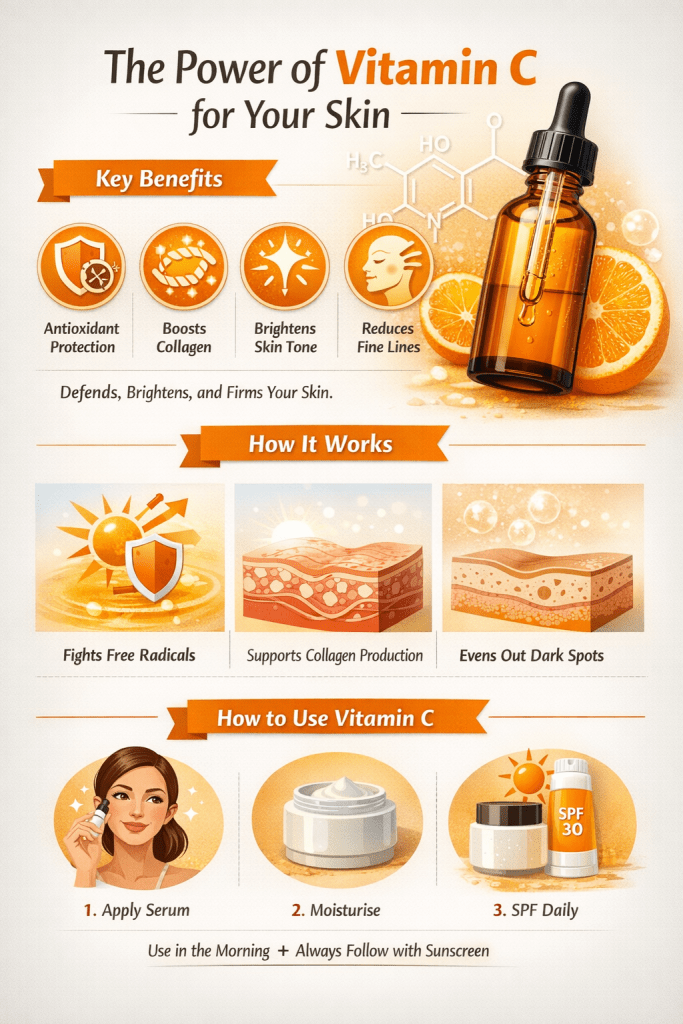
Vitamin C is a multifunctional, scientifically validated ingredient that belongs in both prevention and treatment strategies for skin health. It performs three core roles that directly translate to visible benefits.
- Powerful antioxidant action. Vitamin C neutralises free radicals generated by UV light, pollution and metabolic processes. This reduces oxidative damage to lipids, collagen and DNA.
- Essential cofactor for collagen synthesis. Ascorbic acid is required by prolyl and lysyl hydroxylase enzymes to form stable collagen crosslinks. This biochemistry underlies Vitamin C’s ability to support firmness and reduce wrinkle appearance over time.
- Pigmentation control and brightening. Vitamin C reduces melanin formation by interfering with tyrosinase activity and related pathways. Regular use can gradually fade dark spots and improve overall radiance.
Topical delivery places active Vitamin C where it is needed most. Diet alone rarely restores epidermal and dermal levels sufficiently to impact visible ageing. That is why targeted topical products are essential for measurable outcomes.
The biology in plain language
- Cellular transport and uptake. Skin cells import Vitamin C through sodium dependent transporters, especially SVCT2 in dermal fibroblasts. Raising local extracellular Vitamin C raises intracellular supply in these cells and supports collagen production.
- Antioxidant network synergy. Vitamin C interacts with vitamin E and other antioxidants. It can regenerate oxidised vitamin E and interrupt lipid peroxidation chains, creating a defensive network that is stronger than any single antioxidant.
- Gene expression and structural support. Beyond enzymatic cofactor activity, Vitamin C can increase collagen gene expression and stabilise collagen mRNA. This combination of biochemical and transcriptional effects explains short term antioxidant outcomes and longer term structural improvements.
What the clinical evidence tells us
These practical, evidence-based points will help set consumer expectations and design product claims.
- Timelines for noticeable improvement. Instrumented and clinical trials report improvements in brightness, texture and fine lines within 8 to 12 weeks of consistent topical use. Larger structural gains appear with longer use.
- Effective concentrations and vehicles. L-ascorbic acid shows robust effects in 10 to 20 percent concentrations in acidified or low-water vehicles. Stabilised derivatives can perform well at lower concentrations in emulsion formats when they convert to active Vitamin C in the skin or act as antioxidants themselves.
- Synergy amplifies protection. Combination formulas of Vitamin C, Vitamin E and ferulic acid produce greater photoprotective effects than Vitamin C alone. This is a validated approach for enhancing daytime protection.
- Derivative performance. Stable Vitamin C derivatives allow inclusion in lotions and creams and extend shelf life. Their functional activity varies by chemistry and delivery strategy.
Stability and formulation realities explained
Vitamin C is a high value cosmetic active and also a demanding raw material. These are the core formulation facts to keep in mind.
- Ascorbic acid instability. Pure L-ascorbic acid oxidises with exposure to air, light and metal contaminants. Oxidation reduces potency and produces colour changes. That is why pH control, chelation and protective packaging are essential.
- pH and penetration. L-ascorbic acid penetrates best from acidic vehicles. Formulas with pH less than 3.5 and concentrations up to about 20 percent show best epidermal uptake. Above that level irritation risk increases and incremental benefit drops.
- Co-actives that stabilise and boost activity. Vitamin E and ferulic acid stabilise Vitamin C and boost photoprotection in human skin models. Including these co-actives yields stronger real world performance.
- Packaging and handling. Use opaque containers, airless pumps, and avoid glass with loose caps. Minimise headspace and control manufacturing oxygen exposure. Consumer care instructions to store away from heat and light will extend usable life.
Vitamin C derivatives and how they compare
Choosing the right Vitamin C form is a key product decision. Derivatives trade off potency, stability and ease of formulation.
| Vitamin C form | What it feels like on skin | Best suited for | Product stability | Typical use level |
|---|---|---|---|---|
| L-ascorbic acid | Light, fast absorbing, may tingle | Fast visible brightening and anti-ageing | Low | 10–20% |
| Sodium ascorbyl phosphate (SAP) | Very gentle, non-irritating | Sensitive skin, daily moisturisers | High | 0.5–3% |
| Magnesium ascorbyl phosphate (MAP) | Smooth, hydrating | Brightening and barrier-friendly formulas | High | 0.5–3% |
| Ethyl ascorbic acid | Lightweight, slightly silky | Even tone and glow with better stability | Medium to high | 0.5–2% |
| Tetrahexyldecyl ascorbate (THDA / ATIP) | Silky, oil-like, nourishing | Firmness, collagen support, luxury serums | Very high | 0.5–3% |
| Ascorbyl palmitate | Rich, oily | Antioxidant support in oil systems | Low | 0.1–1% |
| Ascorbyl glucoside | Comfortable, lotion-like | Long-term brightening, sensitive skin | High | 1–5% |
Below is a practical guide to the most common types, their chemistry, benefits and formulation tips.
| Vitamin C form | Chemical nature | Solubility | Skin activation mechanism | Penetration profile | Key formulation notes |
|---|---|---|---|---|---|
| L-ascorbic acid | Native ascorbic acid | Water-soluble | Biologically active as applied | High at acidic pH | Requires pH <3.5, highly oxidation-sensitive |
| SAP | Phosphate ester | Water-soluble | Enzymatic dephosphorylation in skin | Moderate | Stable at neutral pH, good for emulsions |
| MAP | Magnesium salt phosphate ester | Water-soluble | Enzymatic conversion in epidermis | Moderate | Compatible with barrier-support systems |
| Ethyl ascorbic acid | Ethylated ascorbic acid | Dual-solubility | Partial direct activity and conversion | Moderate to high | Balances stability and efficacy |
| THDA / ATIP | Lipophilic ester | Oil-soluble | Intracellular enzymatic conversion | High in lipid layers | Excellent stability, slow sustained release |
| Ascorbyl palmitate | Fatty acid ester | Oil-soluble | Limited enzymatic conversion | Low to moderate | Degrades over time, not ideal as primary active |
| Ascorbyl glucoside | Glycosylated derivative | Water-soluble | Enzymatic cleavage of glucose | Moderate | Very stable, slower onset of action |
1. L-ascorbic acid (pure ascorbic acid)
- What it is. The native, biologically active form of Vitamin C.
- Benefits. Fast acting antioxidant, supports collagen synthesis directly and reliably in clinical trials.
- Challenges. Highly unstable in water, sensitive to air and metals, requires acidic pH for skin uptake. Product may yellow with oxidation.
- Use tips. Best for serums and low-water anhydrous or acidified vehicles. Target 10 to 20 percent and pH < 3.5 for strong uptake. Add vitamin E and ferulic acid to stabilise and improve photoprotection.
2. Sodium ascorbyl phosphate (SAP)
- What it is. A water soluble phosphate ester that is stable at neutral pH. It converts to ascorbic acid in the skin via enzymatic cleavage.
- Benefits. Much greater stability in aqueous systems, gentle on sensitive skin, proven antioxidant activity.
- Typical use levels. 0.5 to 3 percent in creams and lotions.
- Stability note. SAP retains potency far better than plain ascorbic acid. Supplier data often shows good stability for 12 to 24 months under appropriate storage.
- Use tips. Good for mass market lotions and for products targeting sensitive skin.
3. Magnesium ascorbyl phosphate (MAP)
- What it is. Similar to SAP, a phosphate ester that converts to ascorbic acid in the skin.
- Benefits. Stable in water based formats and shows brightening effects.
- Typical use levels. 0.5 to 3 percent depending on derivative potency and vehicle.
- Use tips. Often selected for daytime moisturisers and serums where neutral pH is desirable.
4. Ethyl ascorbic acid
- What it is. An ethylated derivative that balances stability and skin penetration.
- Benefits. Better lipid solubility than phosphate esters and improved tolerance versus raw ascorbic acid. Demonstrates brightening and antioxidant effects.
- Typical use levels. 0.5 to 2 percent.
- Use tips. Suitable for both serums and emulsions where some lipophilicity helps penetration.
5. Tetrahexyldecyl ascorbate (THDA or ATIP)
- What it is. A lipophilic, oil soluble Vitamin C ester that penetrates into the lipid layers of skin and is enzymatically converted to active Vitamin C inside cells.
- Benefits. Excellent stability in oil phases and strong evidence for improving firmness and collagen related endpoints in finished products. Gentle on skin and compatible with sunscreen systems.
- Typical use levels. 0.5 to 3 percent depending on potency and vehicle.
- Stability data. In practice ATIP shows much lower assay loss over months versus L-ascorbic acid. For example, some supplier data report under 15 percent loss at 6 months under normal storage.
- Use tips. Ideal for oil serums and lightweight emulsions. Pair with tocopherol for antioxidant synergy.
6. Ascorbyl palmitate
- What it is. A lipophilic ester designed to blend in oil phases.
- Benefits. Initially attractive for oil formulas.
- Challenges. Relatively poor stability and inconsistent conversion to active Vitamin C in the skin. Supplier and literature data show significant potency loss in months for some formats.
- Use tips. Use cautiously, avoid as a primary Vitamin C in products that promise fast brightening or collagen endpoints.
7. Ascorbyl glucoside and other glycosylated forms
- What it is. Sugar conjugates designed for stability and gradual release of active Vitamin C via skin enzymes.
- Benefits. Good stability and gentle profile.
- Use tips. Useful in formulations aimed at sensitive consumers or in products that prioritise shelf life over rapid action.
8. Conversion and skin activation
- Important note. Some derivatives act directly as antioxidants in their own right. Others rely on enzymatic conversion in the skin to release free ascorbic acid. Performance depends on conversion efficiency, skin enzyme activity and the delivery system. Validate finished product epidermal uptake when derivative-based claims are important.
9. Practical derivative selection matrix
- Serums for fast results. L-ascorbic acid 10 to 20 percent in acidified, low-water vehicle, with vitamin E and ferulic acid.
- Mass market creams and lotions. SAP or MAP for stability and tolerability at neutral pH.
- Oil serums and luxury textures. THDA/ATIP for stability and skin delivery in oil phases.
- Sensitive skin lines. SAP, MAP or ascorbyl glucoside for gentleness and shelf life.
Choosing the right Vitamin C for your skin
| If your skin goal is… | Look for this type |
|---|---|
| Fast brightening and glow | L-ascorbic acid |
| Sensitive or reactive skin | Sodium or magnesium ascorbyl phosphate |
| Lightweight daily serum | Ethyl ascorbic acid |
| Nourishing oil serum | Tetrahexyldecyl ascorbate |
| Long-term gentle brightening | Ascorbyl glucoside |
How consumers should use Vitamin C for best results
- Morning use preferred. Apply Vitamin C after cleansing and before sunscreen to reduce daytime oxidative stress.
- Combine with sunscreen. Vitamin C complements sunscreen. Use both for ideal photoprotection.
- Introduce gradually. For new users start with lower concentrations and increase frequency as tolerated.
- Watch for colour changes. Yellow or brown tint usually signals oxidation. Advise replacement when product is visibly discoloured.
- Layering guidance. Use vitamin C before oil based products and before moisturiser. Space strong exfoliants and vitamin C if irritation appears.
Claim language and marketing that stays evidence aligned
Use clear, verifiable statements that match your clinical support.
- Claim safe examples:
- Helps protect skin from environmental damage and supports visible brightness with regular use.
- Helps support collagen production and reduces the appearance of fine lines after consistent use.
- For stronger efficacy claims such as “reduces wrinkle depth” ensure you have finished product clinical data in the exact product matrix used in marketing claims.
Practical checklist for product teams
- Verify raw material COA for purity and trace metal content. Metal chelators such as EDTA can be useful to slow oxidation.
- Design vehicle and pH for your chosen form. L-ascorbic acid requires acidic vehicles, SAP and MAP work at neutral pH.
- Include complementary stabilisers such as vitamin E and ferulic acid when possible.
- Select packaging that limits oxygen and light. Airless pumps and amber glass with tight caps work well.
- Run accelerated stability and real-time shelf life assays, including assay retention and peroxide formation testing.
- Validate skin penetration or epidermal increases for claim substantiation.
Consumer safety and realistic expectations
Vitamin C is well tolerated for most users. Acidic formulations may cause transient tingling or irritation. For those with rosacea, eczema or highly reactive skin consult a dermatologist before starting strong Vitamin C treatments. Consistent use is key. Expect measurable brightness and texture improvements in 8 to 12 weeks and structural collagen support with longer use.
FAQ
Q. Is vitamin C safe during pregnancy?
A. Most topical vitamin C forms are considered safe in pregnancy, but always recommend consulting a healthcare professional for prescription or combined active regimens.
Q. Can I use vitamin C with retinol?
A. Yes. Retinol and vitamin C are complementary. For highly reactive skin, apply vitamin C in the morning and retinol at night. If irritation occurs, stagger introduction or reduce frequency.
Q. How long until I see results?
A. Antioxidant benefits are measurable quickly. Visible improvements in tone, brightness and texture typically appear after 8 to 12 weeks of consistent use. Structural collagen improvements continue with longer use.
Q. Which vitamin C is best?
A. It depends on your product goals. L-ascorbic acid offers the most direct evidence for rapid antioxidant and collagen effects in the skin. Stabilised derivatives are better choices in some vehicles and for longer shelf life. Formulation and delivery are as important as the active itself.
References
- Fitzpatrick R, Rostan E. Double-blind, half-face study comparing topical vitamin C and vehicle for rejuvenation of photodamage. Clinical trial showing improvement in wrinkling after 12 weeks.
- Humbert PG, et al. Topical ascorbic acid on photoaged skin. Clinical study showing benefit with 5 percent vitamin C.
- Pinnell SR, et al. Topical L-ascorbic acid percutaneous absorption studies and formulation characteristics for delivering L-ascorbic acid into skin. Found pH and vehicle variables that determine uptake.
- Shen J, et al. Ascorbate oxidation by iron, copper and reactive oxygen species. Detailed mechanistic study of metal catalysed oxidation.
- Lin FH, et al. Ferulic acid stabilizes a solution of vitamins C and E and doubles its photoprotection of skin. Found significant synergy and improved photoprotection.
- Yin X, et al. Chemical stability of ascorbic acid integrated into formulations. Review of stabilization strategies and shelf life management.
- BASF technical documentation on sodium ascorbyl phosphate. Stability and storage guidance for SAP and MAP derivatives.
- Al-Niaimi F, et al. Topical Vitamin C and the Skin. Review covering mechanisms of action and topical applications.
 Aryan Kenia
Leave a comment