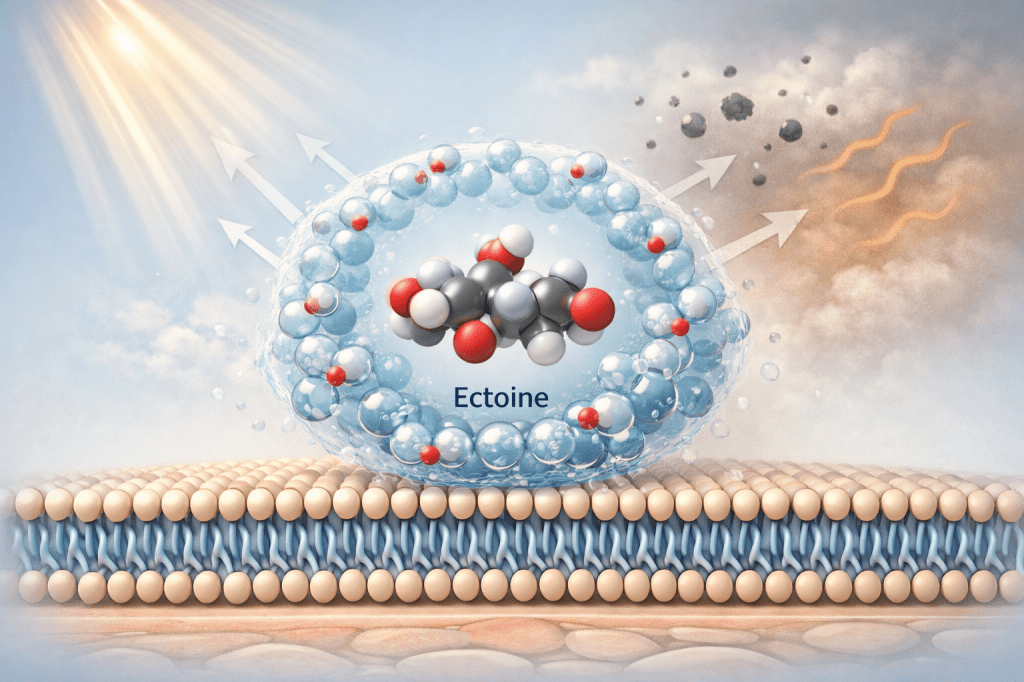
What ectoin is
Ectoin is a natural, low-molecular-weight compatible solute produced in high amounts by halophilic and osmoadapted bacteria. Chemically, it is a tetrahydropyrimidine carboxylic acid derivative and appears as a white, water-soluble powder in its commercial form. Its biochemical role in microbes is to protect proteins, membranes, and cellular structures from osmotic, thermal, and radiation stress.
How ectoin works: mechanistic summary useful for claims
From a formulation and mechanism standpoint, two complementary actions explain ectoin’s performance in topical applications.
- Water structuring and kosmotropic effects. Ectoin promotes an ordered hydration shell around biomolecules and lipid bilayers, increasing protein and membrane stability under stress.
- Direct membrane and cell protection. By stabilizing lipid bilayers and cell membranes, ectoin reduces leakage and surfactant-induced damage, helping to preserve barrier function under environmental stress.
These mechanisms translate into measurable downstream endpoints such as reduced transepidermal water loss, maintenance of skin moisture after dehydration, and lower markers of cellular damage following UV or pollutant exposure.
Evidence from human and in vitro studies
The clinical evidence base for ectoin is moderate but consistent across multiple study types.
- Hydration and anti-aging endpoints. Vehicle-controlled human studies with formulations containing around 2 percent ectoin show significant improvements in skin hydration and reductions in surface roughness and scaling versus control. Elasticity parameters trend positively but are not always statistically significant.
- Atopic dermatitis. Randomized intra-individual trials report ectoin-containing creams to be comparable to barrier-support creams in reducing SCORAD scores and pruritus in mild to moderate atopic dermatitis.
- UV, photoaging, and pollution protection. Preclinical and clinical datasets indicate reduced UV-induced cellular damage and lower pollutant-associated oxidative and matrix-degrading markers.
- Molecular and cellular studies. In vitro studies demonstrate reduced stress signaling, lower mitochondrial DNA damage following UVA exposure, and the induction of protective heat shock proteins in keratinocytes.
Manufacture and sourcing
Ectoin is produced commercially by microbial fermentation, typically using halophilic organisms such as Halomonas elongata. Production methods include fermentation followed by downstream recovery approaches such as aqueous biphasic systems, bacterial milking, and metabolic engineering. Cosmetic and pharmaceutical grades are supplied by specialized ingredient manufacturers.
Safety and recommended use levels
Across published literature and supplier safety data, ectoin shows low irritation and allergenic potential and is widely tolerated by sensitive skin. Recommended topical use levels typically range from 0.3 to 2.0 percent. Standard industrial hygiene practices apply to raw material handling. For finished products, patch testing remains a prudent step during clinical validation.
Practical formulation and claim guidance
If I were advising a product team or writing claims, I would recommend the following approach.
- Target concentration and vehicle. Use 0.5 to 2.0 percent ectoin in leave-on formulations for hydration and barrier claims. Lower levels may be suitable in combination anti-pollution concepts.
- Claiming language. Focus on barrier support, hydration, irritation reduction, and protection from environmental stressors. Avoid medical claims unless pursuing regulated pathways.
- Formulation compatibility. Ectoin is water-soluble and compatible with most emulsions and serums. It pairs well with humectants, ceramides, and antioxidants. Validate pH stability and active compatibility.
- Differentiation and positioning. Position ectoin as a multifunctional protectant combining hydration and environmental protection. Small randomized vehicle-controlled panel studies can support credible claims.
Limitations
Ectoin is well supported for barrier and protective claims, but should not be positioned as a universal anti-aging solution. Evidence favors hydration, barrier reinforcement, and protection from acute environmental stress rather than deep dermal remodeling. Products targeting medical indications require separate regulatory pathways.
References
- PubChem: Ectoine (CID 126041)
- Graf R et al. Clinics in Dermatology, 2008
- Heinrich U et al. Skin Pharmacol Physiol, 2007
- Marini A et al. Skin Pharmacol Physiol, 2014
- Ng HS et al. Processes, 2023
 Aryan Kenia
Leave a comment